
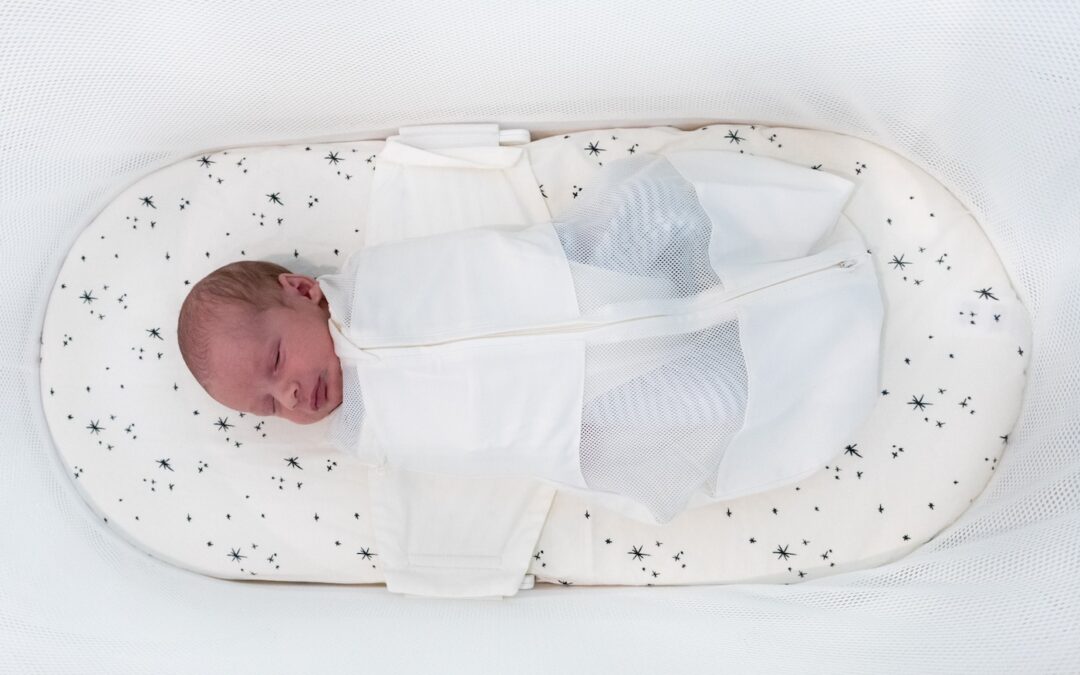
Reliable, large-scale longitudinal data on infant sleep development has historically been hard to come by. Most published studies are small, conducted at only one or two time points, and rely on methods with well-documented limitations (Happiest Baby’s research team recently published an overview of this literature in Frontiers in Neuroscience). But a new study published in Sensors asks whether activity logs from SNOO, a commercially available responsive bassinet, can support population-level sleep monitoring across the first six months of life.
Researchers from the University of Southern California and Happiest Baby Inc (maker of SNOO) conducted a secondary analysis of de-identified activity logs from more than 26,000 babies who used SNOO Smart Sleeper. Because the device automatically adjusts its motion and sound output in response to infant cries, its time-stamped state changes double as indicators for periods of sleep and fussing. The researchers developed a method to derive traditional sleep metrics (total night sleep, longest sleep stretch, and sleep efficiency) alongside novel metrics capturing fussing resolution and the timing of caregiver intervention—measures that have been largely absent from prior infant sleep research.
What They Found
SNOO-derived sleep values were generally similar to diary-based reports at the very beginning and end of the 6-month age range, but rose to peak values faster, creating a notable difference of about an hour in the middle months. By around 4 months, babies were sleeping for around 10 hours per night, with longest stretches of continuous sleep lasting around 7 hours.
The novel fussing metrics showed that roughly half of nighttime fussing episodes resolved within SNOO without caregiver intervention, and that when episodes resolved successfully, infants typically remained in the bassinet for several additional hours before caregiver intervention was needed. The authors note this pattern is consistent with what might be expected from a responsive soothing system, while being explicit that the study was not designed to estimate SNOO’s effects.
Why It Matters
The study’s broader contribution lies in what the methodology makes newly visible: Nightly measures derived from an interactive system that captures activity from the infant, the device, and the caregiver together, which are dynamics that traditional sleep monitoring has not been able to quantify at scale.
The study shows that daily-resolution, longitudinal monitoring of both infant sleep and caregiver interaction dynamics is feasible at population scale using consumer IoT device logs. This approach is unique and may reflect important aspects of caregiving experience that traditional sleep monitoring doesn’t fully capture. Further investigation into the use of this technology for monitoring or intervention are warranted.